Snow Canyon trail guide
Sands, Slickrock and Lava Tubes: Exploring Snow Canyon State Park From Head to Toe
Red sandstone, black lava and soft red sand, about 37 minutes from camp.
Snow Canyon packs three landscapes into one 7,400-acre park.
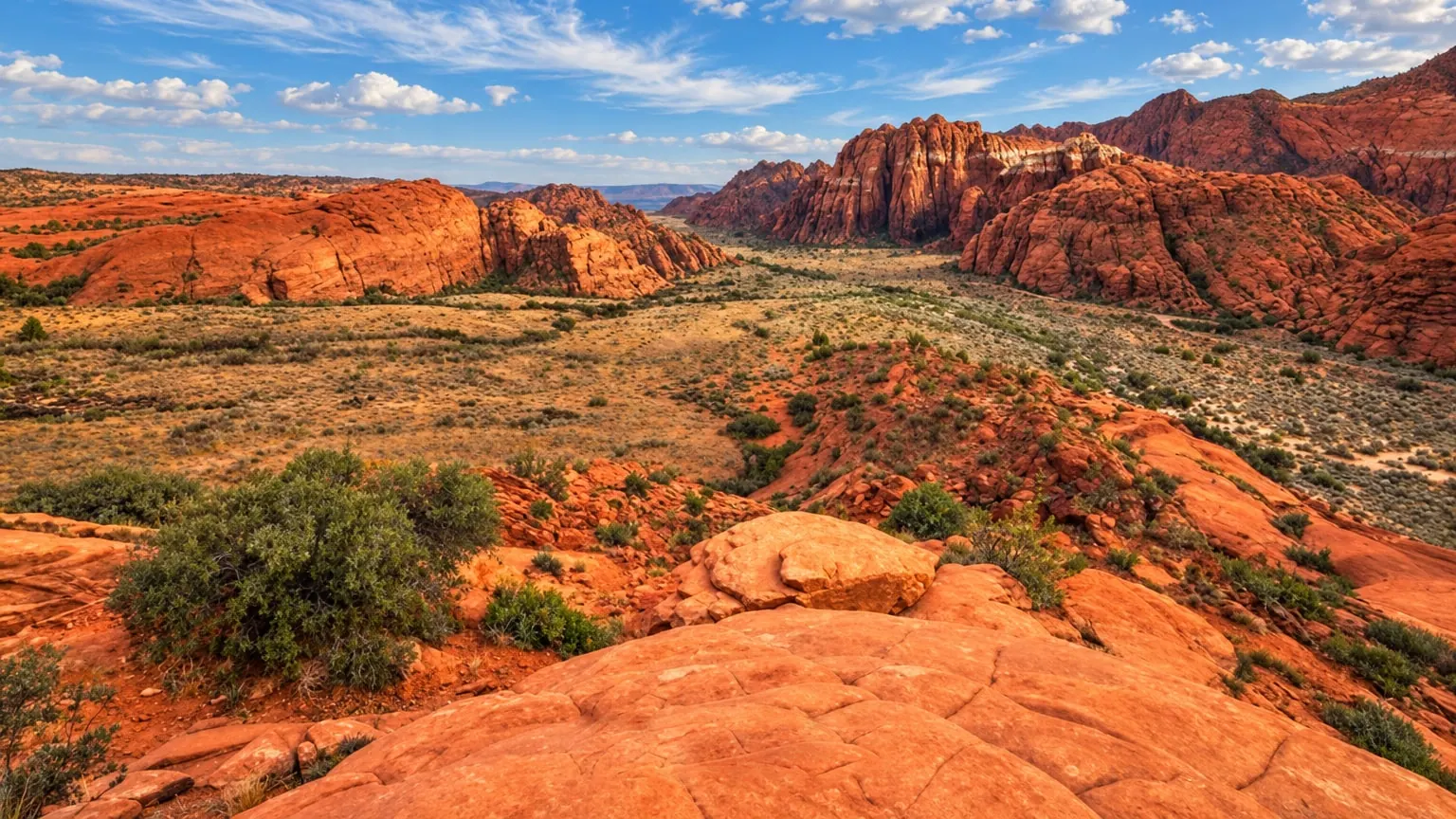
Red Navajo sandstone. Black lava. Soft red sand. Here the Colorado Plateau, the Mojave Desert and the Great Basin all meet. It's one of the best family hiking days in Southern Utah, and it's about 37 minutes from Jellystone Park™ Zion. For the full trail comparison, see our Snow Canyon State Park guide.
Getting there from base camp
From Jellystone Park™ Zion in Hurricane:
- South Entrance (Ivins): about 22 miles, ~37 minutes via I-15, Red Hills Parkway and Snow Canyon Parkway.
- North Entrance (SR-18): about 25 miles, ~36 minutes.
These are free-flow, approximate estimates.
Pro move: enter at the south and exit at the north, or the other way around. Snow Canyon Drive runs the full length of the main canyon. Your day pass also covers the outside lots at Cinder Cone, Whiterocks, Gila, Snow Canyon Scenic Overlook and Chuckwalla.
Heads up
On Saturday, November 14, 2026, Snow Canyon Drive closes 7 a.m. to noon for the Snow Canyon Half Marathon and 10K. The paved Whiptail Trail closes too. Call the park at 435-628-2255 with questions. Checked November 10, 2026
The geology in one minute
You don't need a degree to read this canyon.
- Navajo sandstone: ancient wind-blown dunes turned to stone. Look for cross-bedding lines on the Petrified Dunes.
- Kayenta sandstone: you'll see it near the Scout Cave trail.
- Lava flows: the Lava Flow trail crosses a 27,000-year-old lava flow.
- Cinder Cone: an extinct volcano that helped shape the canyon and its black lava flows.
- Basalt-capped cliffs: these were once valley bottoms.
- Moqui marbles: small iron balls on the Petrified Dunes. Photograph them and leave them in place.
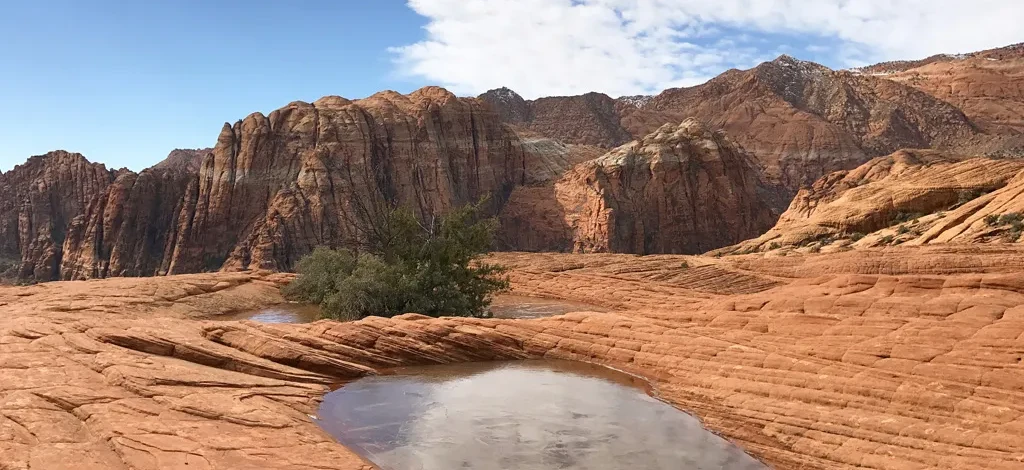
Key takeaway: in one morning you can walk on frozen dunes and then on lava. Few parks give kids that contrast so close together.
Family-friendly trails, from easiest to biggest payoff
Distances are round trip, from Utah State Parks' hiking page and September 2026 trail brochure.
Jenny's Canyon (0.5 mi, easy, about 20 min)
The official brochure calls it a "great children's trail." A sandy path and a dry wash lead to a short sculpted slot canyon. Watch for owls, ravens and peregrine falcons nesting in the slot.
Petrified Dunes (1.2 mi, moderate, about 40 min)
Navajo sandstone slickrock you can explore freely. Once you're on the rock, you may roam the sandstone. It's one of the park's designated scrambling areas. There's little shade.
Pioneer Names (0.5 mi, easy, about 20 min)
Pioneer names written in axle grease, dating back to 1881. It has the most shade of any hike in the park, plus a small arch.
Sand Dunes (0.5 mi, easy, about 15 min)
A giant red sandbox. Kids can roam the dunes freely. A small roadside lot gives quick access, and it's a good spot for a picnic.
Tortoise Walk (0.3 mi, easy, about 10 min)
ADA accessible. A wide, compacted path ends at a 4,200 lb granite tortoise sculpture. It's a great stroller option.
Lava Flow and the lava tubes (2.5 mi, moderate, about 1.5 hr)
The headline trail. It crosses uneven black lava rock to two lava tubes, at the 3rd and 4th education signs.
- Bring flashlights. No glow sticks.
- Wear sturdy shoes. Lava rock is sharp and uneven.
- Pair it with the Butterfly Trail (2 mi) for a sandstone staircase and the West Canyon Overlook.
Johnson Canyon (2 mi, easy, about 1 hr)
Closed every year March 15 to September 14 to protect wildlife, except on ranger-guided hikes. In the open season, it leads to Johnson's Arch, about 200 feet across. After steady rain, a waterfall may flow. Check current conditions before you go.
Cinder Cone (about 1.5–2 mi, difficult, about 2 hr)
For older kids and adults. Climb about 500 feet to the top of an extinct volcano on loose lava clinkers, with no shade.
Key takeaway: with young kids, do Jenny's Canyon, Sand Dunes and Petrified Dunes. With older kids, do the Lava Flow tubes and Cinder Cone.
Dark sky photography in Snow Canyon
Snow Canyon is a designated Urban Night Sky Place, just minutes from St. George.
How to plan a night shoot
- Mind the hours. Day-use hours end at 10 p.m. Plan your sunset-to-stars window inside that.
- Scout in daylight. The Petrified Dunes and the Sand Dunes give you clean silhouettes against the sky.
- Bring a red-light headlamp to protect your night vision, plus a tripod and layers. Desert nights cool fast.
- Check the moon. Shoot near the new moon for the Milky Way.
Base camp play: hike in the morning, rest through the heat of the day, then drive back for blue hour. You'll still be back at Jellystone Park™ Zion before the late campfire burns down.
Timing, heat and wildlife
- Summer: Utah State Parks advises avoiding hiking from 11 a.m. to 7 p.m. in the hottest months, and says daytime temperatures in July and August frequently top 105°F. Carry 32 ounces of water per person, per hour. Hot ground is hard on paws and small hands.
- Spring and fall: this is the best desert tortoise viewing. Babies can look like rocks.
- Fall and winter: this is prime hiking weather, and Johnson Canyon is open from Sept 15 to Mar 14.
- Snakes: 11 species live in the park. Only two are venomous, the Great Basin rattlesnake and the Mojave sidewinder. Watch where you put your hands.
Your Southern Utah base camp
Why Jellystone Park™ Zion makes Snow Canyon better
Jellystone Park™ Zion is the ultimate luxury base camp for all things Southern Utah adventure, and Snow Canyon is a perfect half-day from camp.
- Lava rock and sand, then water. In season, cool off in the Yogi Bear™ Water Zone, with slides, a lazy river and a floating obstacle course on the lake; it reopens March 13, 2027. Off-season, campers have a heated lap pool and hot tub.
- Real beds after a scramble. Choose a glamping cabin or a full-hookup RV site for rigs up to 75 feet. Comparing options? Read the best campgrounds near Snow Canyon.
- Campfire evenings. Swap trail stories by your site's fire pit.
- One base, many parks. Snow Canyon, Sand Hollow, Zion and Tuacahn all work as day trips from one address. See entering Zion from the west, and think of Tuacahn as Snow Canyon by day, Tuacahn by night. Browse more things to do near our Southern Utah base camp.
Plan your Snow Canyon base camp at Jellystone Park™ Zion.
People also ask
How long do you need in Snow Canyon State Park?
One to four hours covers most families. The park's own one-hour visit is a drive through the canyon, a stop at the Scenic Overlook and one short hike.
What is the easiest hike in Snow Canyon?
Tortoise Walk (0.3 mile, ADA accessible) and Jenny's Canyon (0.5 mile) are the easiest. Jenny's Canyon adds a short slot canyon that kids love.
Is Snow Canyon worth visiting if you've seen Zion?
Yes. It's smaller and quieter, with lava tubes, open slickrock and sand dunes you won't find in Zion Canyon.
Can you go inside the lava tubes at Snow Canyon?
Yes. The Lava Flow trail (2.5 miles round trip) reaches two tubes at the 3rd and 4th education signs. Bring flashlights; glow sticks are not allowed in the tubes.
How much does Snow Canyon State Park cost?
When we checked on November 10, 2026: $20 per vehicle for non-residents and $15 for Utah residents (up to 8 people), and $3 per person on foot or bike. The park is open 6 a.m. to 10 p.m. daily.
Sources & official links
- Snow Canyon State Park (Utah State Parks) · Current conditions · Park fees
- Hiking · Know before you go · Trail guide & map (Sept 2026, PDF)
Facts were checked on November 10, 2026. Drive times are approximate and assume no traffic. This guide is published by Jellystone Park™ Zion and is not affiliated with Utah State Parks. Book now.